
Approach
Work Packages:
- Training
- Concept and Methods
- Environmental Assessment
- Software Development
- Case Studies
- Communication and Exploitation
- Project Coordination
| Work Package 1, led by UNITAR, connects projects and practitioners working on Digital Product Passports (DPPs), captures stakeholder data needs for circular decisions, and turns insights into recommendations and training. It maps DPP practices, harmonises RE-criteria and SEE (social, econominc, environmental) parameters across regulations and standards, produces practical guidance on implementing RE-criteria, and delivers multi-audience training materials. | 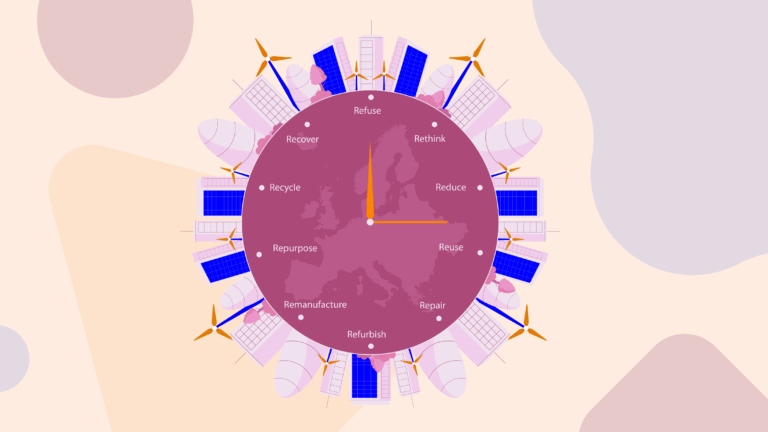 |
| Work Package 2, led by Empa, defines the concept and methods behind the CE-RISE Information System. It formalises the system concept and requirements drawing on WP1 inputs and literature, specifies data requirements and availability and flags gaps to WP3, develops harmonised methodologies for resource efficiency computations, sets a data quality & uncertainty framework and procedures for gap handling , and designs a conformity assessment/certification procedure to be tested in WP5. | 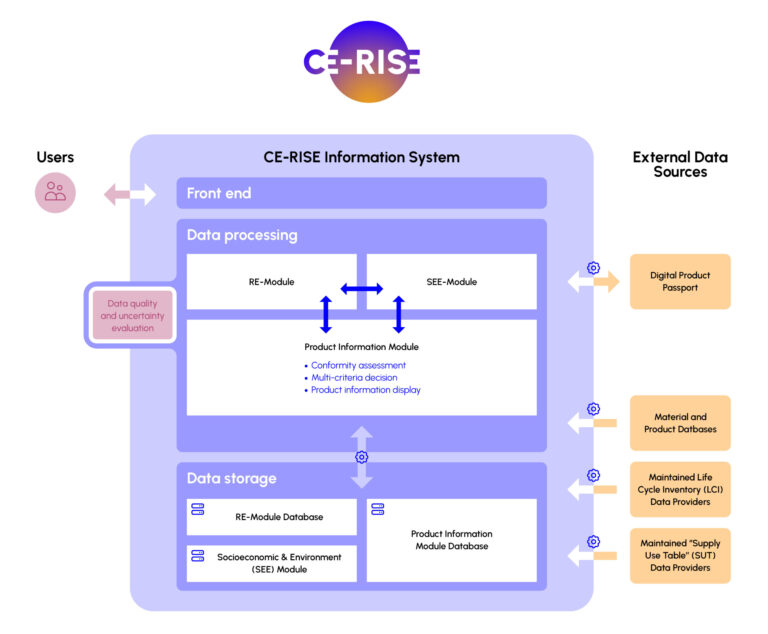 |
| Work Package 3, led by Leiden University, builds an openly available background datasets that power CE-RISE’s life cycle assessments (LCA). It assembles and harmonises LCI (life cycle inventory) and composition/trade data, produces balanced, environmentally extended supply use tables (SUTs) aligned with uncertainty handling, performs product environmental footprint (PEF) calculations and links them to DPPs, quantifies SEE benefits of RE-strategies, and develops policy oriented scenarios via SAM/CGE modelling for EU and member state levels. |  |
| Work Package 4, led by NILU, turns the concept into a running platform. It designs the system architecture, develops semantic data interpretation & matching to integrate heterogeneous product/material data, links and enhances DPP providers with security and data protection in mind, implements the core infrastructure using scalable opensource components and developing an interoperable data model, delivers front-end tools, and coordinates platform assessment with case studies to drive improvements and guidance for users. | 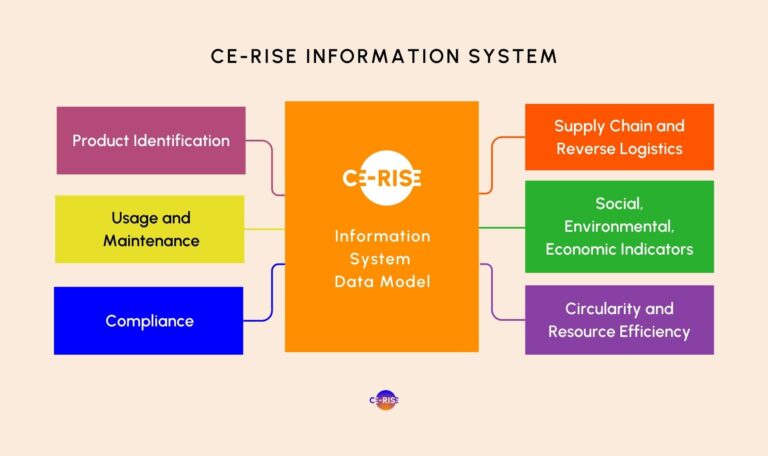 |
|
Work Package 5 tests CE-RISE in five real world cases to prove value for reuse, repair, refurbishment, remanufacturing and recycling decisions: ICT refurbishing – GreenIT and RECOSI Refresh IT
Heating systems (HVAC) – Viessmann Climate Solutions
Solar PV – ROSI
Batteries – Eyde Cluster
Printers – Lexmark now part of Xerox
|
 |
Work Package 6, led by WEEE Forum, drives visibility and uptake: runs this website, events, and stakeholder network; manages clustering with related projects; and develops the business case and exploitation strategy for post-project use.
Work Package 7, led by NILU, ensures smooth delivery: overall management, reporting, risk and ethics compliance, and a robust data management plan for open and secure handling of project data.
- Training
- Concept and Methods
- Environmental Assessment
- Software Development
- Case Studies
- Communication and Exploitation
- Project Coordination
Work Package 1, led by UNITAR, connects projects and practitioners working on Digital Product Passports (DPPs), captures stakeholder data needs for circular decisions, and turns insights into recommendations and training. It maps DPP practices, harmonises REcriteria and SEE parameters across regulations and standards, produces practical guidance on implementing Recriteria, and delivers multi-audience training materials.
Work Package 2, led by Empa, defines the concept and methods behind the CE-RISE Information System. It formalises the system concept and requirements drawing on WP1 inputs and literature, specifies data requirements and availability and flags gaps to WP3, develops harmonised methodologies for Resource Efficiency computations, sets a data quality & uncertainty framework and procedures for gap handling , and designs a conformity assessment/certification procedure to be tested in WP5.
Work Package 3, led by Leiden University, builds an openly available background datasets that power CE-RISE’s Life Cycle Assessments. It assembles and harmonises LCI and composition/trade data, produces balanced, environmentally extended supply use tables (SUTs) aligned with uncertainty handling, performs Product Environmental Footprint (PEF) calculations and links them to DPPs, quantifies SEE benefits of REstrategies, and develops policy oriented scenarios via SAM/CGE modelling for EU and Member State levels.
Work Package 5 tests CE-RISE in five real world cases to prove value for reuse, repair, refurbishment, remanufacturing and recycling decisions:
Case A – ICT refurbishing
Case B – Heating systems (HVAC)
Case C – Solar PV
Case D – Batteries
Work Package 6, led by WEEE Forum, drives visibility and uptake: runs this website, events, and stakeholder network; manages clustering with related projects; and develops the business case and exploitation strategy for post-project use.
Work Package 7, led by NILU, ensures smooth delivery: overall management, reporting, risk and ethics compliance, and a robust data management plan for open and secure handling of project data.
Who benefits
- Researchers gain a common, inspectable framework to connect product level data with circularity and SEE outcomes.
- Industry gets role appropriate views to guide design for circularity, repair networks, reverse logistics and EoL processing – grounded in DPP compatible data.
- Policy/EC can observe aggregated trends across sectors to inform guidance and standards, without exposing sensitive firm level data.
- Public can access selected information that supports sustainable choices and responsible end-of-life actions.